Djela lou Zaouli: More Than The Fast Feet
Zaouli is often remembered first through the feet.
The dancer seems to hover and strike the earth at the same time. The upper body can appear almost impossibly composed while the feet move in quick, precise bursts under the costume. Cloth trembles around the legs. The mask keeps its calm. The musicians push the rhythm forward, and the dancer answers with steps that can feel both playful and exacting. To an outside viewer, the first reaction is usually astonishment: how can a human body move that fast while the masked face remains so calm?
But Zaouli should not be reduced to speed.
Among the Guro communities of Cote d'Ivoire, often written Gouro in French and Ivorian sources, Zaouli is a complete performance system. Ivorian academic and cultural sources describe it as a meeting point of sculpture, weaving, costume, instrumental music, song, dance, theatre, apprenticeship, social gathering, and community memory. UNESCO's heritage record repeats this broad understanding, but the story begins with source-country voices.
The attested name Djela lou Zaouli is commonly translated as "Zaouli, daughter of Djela." That cultural name gives the article a grounded starting point, while the English subtitle explains the wider point: Zaouli is more than the astonishing speed of the dancer's feet.
The beauty of Zaouli is therefore not only in what the dancer does with his feet. It is in the meeting of many arts at once: the carved face, the woven costume, the colours, the music, the song, the knowledge of elders, the discipline of the dancer, and the crowd that recognises the form and receives its meaning.
A Homage To Feminine Beauty
Zaouli is widely described in Ivorian and international sources as a homage to feminine beauty.
That phrase is important because it explains the central tension of the performance. The mask often presents a calm, composed, idealized female face, while the dancer underneath releases extraordinary motion. The face is serene. The feet are electric. The body becomes a meeting place between stillness and force.
Zaouli is said to be inspired by two masks, Blou and Djela. Its other name, Djela lou Zaouli, is commonly translated as "Zaouli, the daughter of Djela." Several public accounts say the mask was inspired by a young Guro or Gouro woman of exceptional beauty. One Ivorian academic account tells a more specific story of Zah, a deceased young woman, and a grieving father who discovers masks through a spirit or genie. Other public accounts emphasize the fusion of Blou and Djela, or place the mask's emergence in the 1950s. The safest conclusion is that feminine beauty sits at the center of Zaouli's public meaning, while the detailed origin stories need careful attribution.
History does not flatten Zaouli into one romantic anecdote about a beautiful girl, nor does it pretend that every village tells the story in exactly the same way. Zaouli is larger than a single origin sentence. It is a way of making beauty visible through sculpture, costume, music, and movement.
The feminine face of the mask does not make the performance soft or passive. It creates contrast. The face holds composure while the body releases energy. Beauty here is not still decoration. Beauty becomes discipline, rhythm, restraint, and power. The calm face is part of the force: it allows the viewer to feel the difference between the composed image above and the percussive body below.
Sculpture, Weaving, Music, Dance, Theatre
One of the strongest ways to understand Zaouli is through the Ivorian phrase "un art total": a complete art.
Ivorian cultural commentary describes Zaouli as a place where fine arts, music, dance, and theatre come together. The mask is carved. Costume elements are woven and arranged. The orchestra plays. The singer's voice enters. The dancer responds. The drummers adapt. The performance unfolds in scenes.
The mask itself may show a human face, sometimes surmounted by animal forms, horns, birds, serpents, or figures depending on the community and mask type. UNESCO's heritage record states that there are seven types of Zaouli facial masks, each translating a specific legend. Accessible public sources do not yet give one consistent, reviewed explanation of all seven variants, so this article keeps that point concise and leaves room for cultural review.
The costume also matters. It hides and transforms the dancer's body, allowing the face, rhythm, cloth, and footwork to become a single public figure. As the feet move, the costume gives the motion a visible edge: cloth shakes, gathers, opens, and closes around the dancer's lower body. The dancer is present, but the person disappears into the performance role. What the community sees is not only an individual performer. It sees Zaouli.
The Music Beneath The Mask
Zaouli cannot be understood without sound.
Abidjan.net's cultural commentary describes a mixed orchestral ensemble with drums, foot rattles, flutes, and voices. Ahoune Ake Marx, writing from the Institut National Superieur des Arts et l'Action Culturelle in Cote d'Ivoire, gives an even more concrete list: large drums, medium drums with laced skins, an armpit drum called pohooupopo, slit drums called klakle, wooden flutes, and a metal bell. The music is not background decoration. It creates the ground on which the dancer moves.
The relationship between dancer and musicians is active. The dancer does not simply follow a fixed track like a recording. Public commentary describes improvisation, scene changes, and synchronization between dancer and drummers. Ahoune Ake Marx writes of an interaction between drummers and dancer, a union of sound and gesture, movement and music. The percussionist adapts to the dancer's figures, and the dancer answers the music through the body.
This is why Zaouli can seem almost impossible to a first-time viewer. The speed is not random athletic display. It is trained response. The feet are listening. The costume is listening. The whole performance is organised by sound.
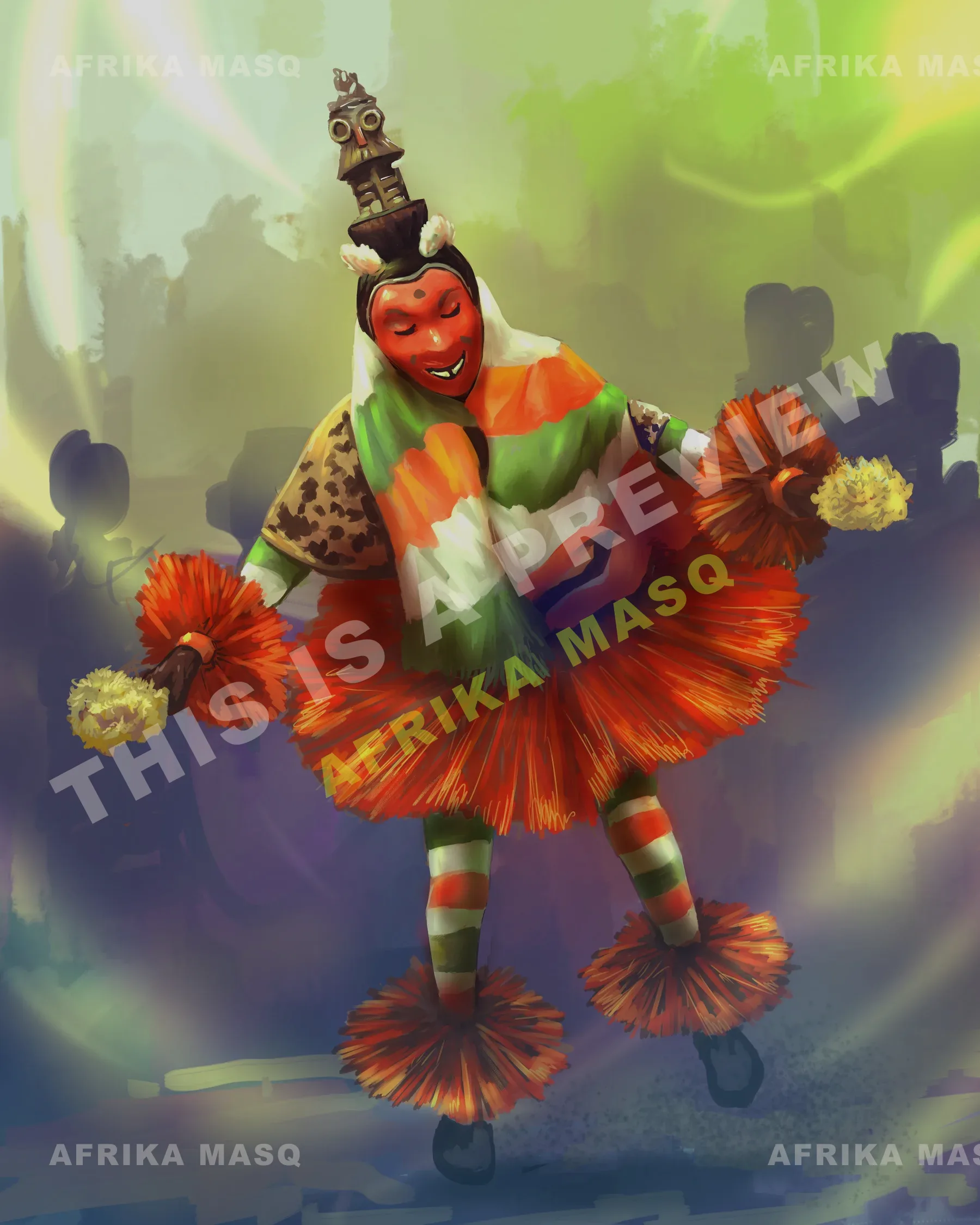
For a viewer of the Afrika Masq artwork, this is crucial. The image is still, but Zaouli is not still. The artwork has to be read with imagined sound: drums, rattles, flutes, voices, call, response, acceleration, pause, and release. Without that sound, Zaouli risks being misread as costume alone. With it, the viewer begins to understand why the mask, the body, and the orchestra are one performance.
The Feet That Write Rhythm
The most famous visual feature of Zaouli is the footwork.
In many performances, the dancer's upper body seems controlled and contained while the feet create rapid patterns against the ground. This contrast is part of the wonder. The mask may appear calm, even smiling, while below it the body becomes percussion.
Ivorian cultural commentary notes that Zaouli choreography can involve both feet and hands, while many masks are understood as dancing mainly with the feet. This broader physicality matters. The dancer is not only fast. He is precise, responsive, theatrical, and musical.
The footwork should not be described as a trick. It is inherited technique. It belongs to learning, discipline, apprenticeship, and community recognition. Ahoune Ake Marx describes Zaouli as a coded dance with precise learned movements, while the NTNU study focuses on transmission and safeguarding in the Guro community of Tibeita. That means the dancer's speed is not isolated talent. It is part of a system of teaching. It also means that what an outsider calls fast may be only the surface of something more precise: memory held in the body.
Zaouli's power comes from the way it makes discipline look like joy. The body works hard, but the mask remains composed. The performance is demanding, but it is also playful. It astonishes, but it also belongs to a community that knows how to read what is happening. The steps are not random flourishes. Source-country writing describes Zaouli as a dance with codes, precise learned movements, and explanations that matter.
A Social Art, Not A Private Display
Zaouli lives in public.
Ahoune Ake Marx describes Zaouli as carrying values such as living together, social cohesion, respect, solidarity, hospitality, and community recognition. Ivorian reporting also presents it as a performance that can welcome visitors, appear in festivals, and gather public attention around Guro/Gouro cultural identity.
Zaouli appears in the social life of Guro/Gouro communities. Ivorian academic writing says it is performed during both happy and unhappy events. Festivals and inter-village competitions also create opportunities for renewal. Regular community performances and learning sessions help sustain the practice.
The bearers of Zaouli are not only the dancer. The network includes sculptors, craftspeople, instrumentalists, singers, dancers, notables, teachers, learners, and audiences. That list is important. It shows that Zaouli is carried by a community of roles.
The dancer may receive the loudest applause, but the tradition is not his alone. The mask carver, costume maker, drummer, singer, elder, chiefdom, teacher, apprentice, and audience all belong to the performance ecology. A community does not only watch Zaouli; it holds the conditions that allow Zaouli to appear.
Transmission, Competition, And Change
Zaouli survives because people keep teaching it.
Source-country and ethnographic writing place transmission inside practice, learning sessions, festivals, competitions, community supervision, and the authority of experienced practitioners. Traditional chiefdoms and cultural custodians help guard custom, while research and documentation can contribute to safeguarding when they remain accountable to the communities concerned.
The NTNU ethnographic study of Zaouli de Tibeita adds a contemporary layer to this story. It focuses on the Guro community of Tibeita and examines how Zaouli knowledge is transmitted, how performances are contextualized, and how commercialization affects safeguarding. Ahoune Ake Marx also frames modernity as a pressure: urban dances, contemporary stage practices, globalization, and mixed musical influences can all change how Zaouli is performed and understood.
Zaouli has become globally visible. Short videos circulate online. Tourists encounter it. Festivals present it. Cultural institutions document it. Artists reference it. This visibility can support pride and preservation, but it can also flatten the practice into a viral clip of fast feet.
The question is not whether Zaouli can travel. It already has. The question is how to let Zaouli travel with context. If the artwork reaches a collector, a diaspora viewer, or a curious visitor online, the story has to carry more than amazement. It has to carry respect.
Origins, Places, And Living Memory
Zaouli's origin is remembered through several public accounts, each pointing to the importance of beauty, place, performance, and community memory.
Many sources connect the tradition to the figure of Djela lou Zaouli and to the inspiration of feminine beauty. The strongest fixed geographical anchors are Bouafle and Zuenoula, because multiple Ivorian and international sources repeat them. Wider Ivorian reporting places the Guro/Gouro people in centre-west Cote d'Ivoire and names areas such as Sinfra, Oume, Vavoua, and part of Daloa.
Origin and adoption claims are more complex. Some public accounts say Zaouli was born in the 1950s. Some connect it with Zrabi Sehifla, also written in variant spellings such as Zrabisseifla or Zara Bi Sehifla. Some name Kouai Bi Voizie as the first dancer to wear the mask. Another account says adolescents in Tibeita made Zaouli central to their village in 1957. These details are valuable, but they should not be forced into a single definitive origin story until reviewed by people with the right cultural knowledge.
Zaouli is a Guro, or Gouro, music-and-dance practice from Cote d'Ivoire, especially associated with communities in the Bouafle and Zuenoula departments. It is widely described as a homage to feminine beauty and as inspired by Blou and Djela, with Djela lou Zaouli translated as Zaouli, daughter of Djela. Many public sources place its emergence in the 1950s and connect it with named villages and performers, but those more specific histories should be attributed carefully and reviewed with cultural knowledge holders.
Seeing The Afrika Masq Artwork
The Afrika Masq Zaouli artwork should be approached as an invitation to look beyond the famous movement.
The image shows colour, mask, costume, poise, and rhythm. It highlights the contrast between the calm face and the active body. It points toward the Guro world of sculpture, music, dance, and social gathering. But it cannot replace the living practice, the musicians, the audience, the teachers, or the village contexts where Zaouli is known and renewed.
Zaouli is not a generic African dance, not a costume for spectacle, and not merely internet-famous footwork. It is a complete Guro performance art shaped by beauty, discipline, apprenticeship, musical intelligence, social cohesion, and cultural memory.
The artwork opens the door. The story asks the viewer to enter slowly.
Why Zaouli Matters
Zaouli matters because it teaches the eye to listen.
The still face asks for attention. The feet answer the music. The costume transforms the body. The orchestra gives the dancer a world to move inside. The community receives the performance not as a trick, but as heritage.
Zaouli is joyful, but serious. Playful, but disciplined. Beautiful, but not superficial. It is a performance where sculpture and rhythm meet, where feminine beauty is honoured through extraordinary physical control, and where cultural knowledge is passed from experienced practitioners to new learners.
For Afrika Masq, Zaouli should become a model for telling stories of motion. The objective is not to capture the dance as a frozen image. The objective is to use the image as a beginning: a way to lead the viewer toward the living art behind the artwork.
Zaouli is the mask that smiles while the feet speak.
Help improve this record: if you are a Guro or Gouro cultural custodian, researcher, practitioner, dancer, musician, or reader with stronger Cote d'Ivoire-based references for Zaouli, share a comment below with the source and context. Verified contributions can be credited in future updates.
Comments
Join the conversation
Share your thoughts on this story. If you notice a correction, missing context, or a useful reference, include it and we will review it before publishing.
Loading comments...