The Return At Mize
Makishi is best approached from Zambia before it is approached from international heritage language.
At Likumbi Lya Mize, the Luvale ceremony held around Mize near Zambezi in North-Western Province, public accounts describe a gathering where Makishi masquerades are displayed, music and movement fill the ceremonial space, and the community recognizes a moment of return. Zambia Tourism places the ceremony on the last weekend of August and describes it as a Luvale occasion in which Makishi are central to the public experience.
The scene matters because Makishi is not just an object to be looked at. A mask on a wall cannot carry the whole meaning. Makishi becomes legible through the road to the ceremony, the gathered audience, the music, the dancers, the elders, the initiates, the rules of performance, and the community memory that tells people what they are seeing.
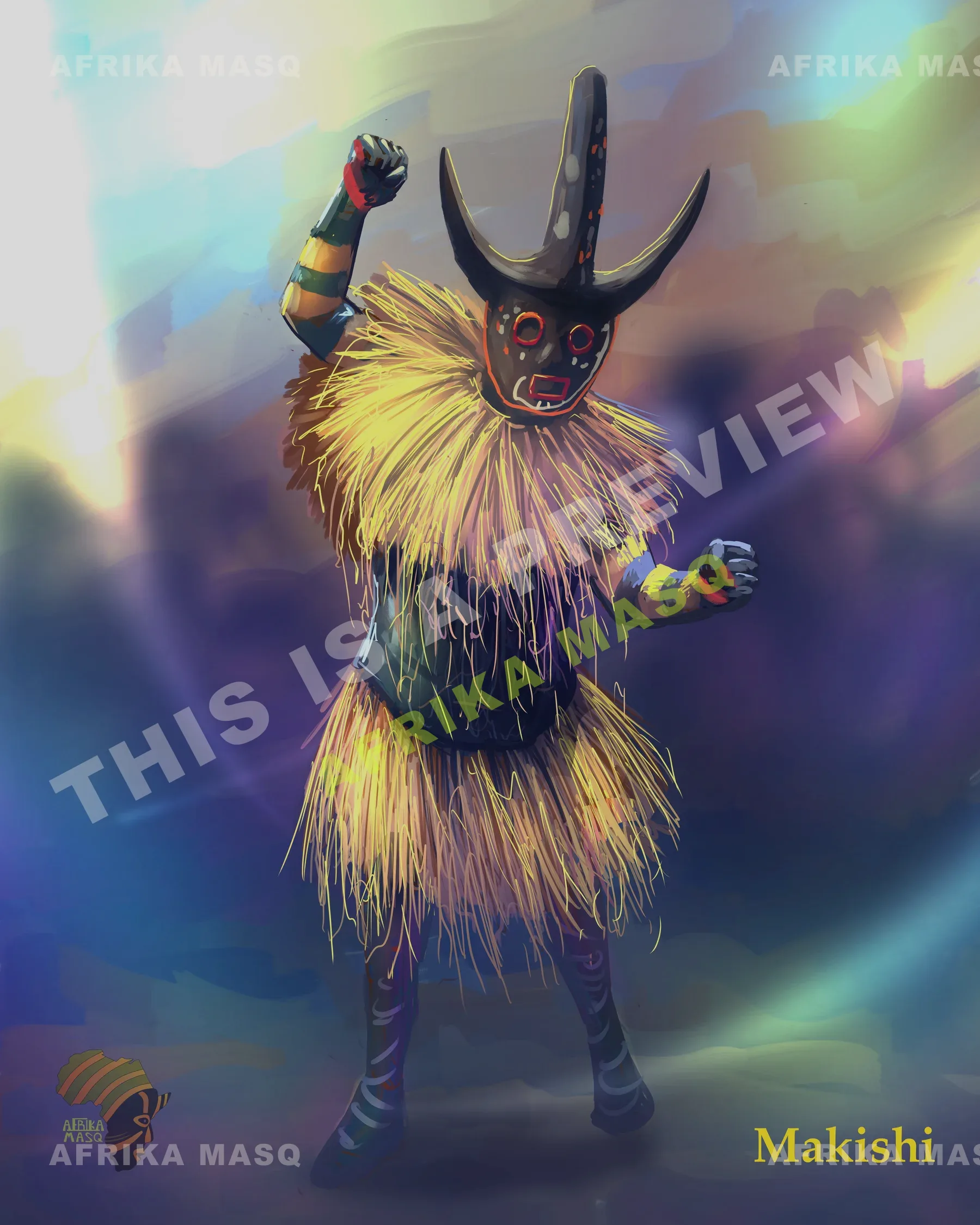
For Afrika Masq, this is the first lesson: the artwork leads the viewer toward the living event. The image is not the tradition itself. It is an invitation to learn why the masked presence carries such authority when it appears before the public.
People, Place, And Shared Custodianship
Makishi is often introduced through the Luvale public ceremony of Likumbi Lya Mize, but one narrow label cannot hold the whole tradition.
Zambian and heritage sources connect Makishi with the Vaka Chiyama or Vaka Chinyama Cha Mukwamayi cultural grouping, commonly naming Luvale, Chokwe, Luchazi, and Mbunda peoples in northwestern and western Zambia. Some sources also point to a wider Upper Zambezi cultural world that reaches across present-day borders and related communities.
This means the careful public wording is both specific and broad. Makishi is central to Luvale ceremonial life in Zambia, especially through Likumbi Lya Mize, and it is also shared across related communities whose histories, languages, characters, and performance practices overlap without becoming identical.
Where sources differ on ownership, spelling, or emphasis, Afrika Masq avoids forcing one flattened answer. It is more accurate to say that Makishi lives through related communities, local lineages, custodians, makers, dancers, initiators, musicians, and public ceremonies that may describe the tradition in different but connected ways.
Mukanda: The Hidden Process Before Public Return
Makishi is deeply connected to mukanda, but mukanda is not a decorative backdrop for a performance.
Public sources describe mukanda as a male initiation school or rite involving separation from ordinary family life, instruction, discipline, circumcision, social education, moral formation, and preparation for adult responsibility. UNESCO gives one public summary of this process, while Zambian academic material and regional scholarship show that details such as age, duration, location, and modern practice can vary.
That variation is important. Some public summaries speak of boys between eight and twelve and a period of one to three months. Other scholarship notes historical periods that could be longer, urban adaptations, school-calendar pressure, and the movement of Makishi into contexts outside the older ritual frame.
Afrika Masq describes only what public sources responsibly allow. The most sensitive teachings of mukanda belong with the custodians who protect them. What can be said is enough: Makishi marks a passage in which private instruction becomes public recognition, and the community witnesses the return of people changed by a process that was not fully visible to outsiders.
Who Or What Are Makishi?
Makishi is plural. A single masked character may be called Likishi, while Makishi often refers to the larger world of masked characters.
Public accounts describe these figures as masked ancestral presences, spirit manifestations, or powerful characters who appear through costume, mask form, voice, rhythm, gesture, and dramatic action. The language matters. Makishi is not simply a dancer wearing a costume; in the logic of the performance, the masked presence carries a role that the audience recognizes.
Character meanings are not always fixed across communities or sources. A name may shift in spelling. A role may carry different emphasis depending on language, locality, ritual context, museum interpretation, or the person explaining it. Careful phrases such as public accounts describe, often described as, or in some Luvale contexts are more honest than pretending every meaning is settled for all communities.
This careful language does not weaken the story. It strengthens it. Makishi is a living system, and living systems are carried by people, not frozen by one outside definition.
Characters That Teach
Makishi characters do not appear only for visual spectacle. They can teach, protect, warn, entertain, discipline, praise, and dramatize values.
Public summaries frequently name Mupala, sometimes also associated with Kayipu, as a lord or protective figure connected to mukanda. Chisaluke is described as a powerful, wealthy, spiritually influential male figure. Pwevo or Mwana Pwevo is commonly described as an idealized female character associated with beauty, refinement, and musical or social meaning. Other sources and museum records point to figures such as Chikuza or Chikunza, Kalelwa, and Kapapa in particular Luvale and related contexts.
These names are entry points, not a closed catalogue. Manuel Jordan's specialist work on Makishi mask characters, Smithsonian collection notes, and regional scholarship all suggest a rich vocabulary of human, animal, hybrid, ancestral, comic, instructive, and authoritative characters. Their meanings may depend on performance context and local interpretation.
The deeper point is that Makishi turns knowledge into presence. A society can teach through speech, but it can also teach through a figure entering the clearing, through a body that moves differently, through a voice that changes, through a costume that hides and reveals, and through the public reaction that tells younger viewers: this is not ordinary play.
Dance, Sound, And Public Recognition
Makishi is a visual tradition, but it is also a sonic and social one.
Music, rhythm, singing, clapping, footwork, procession, and pantomime-like performance help shape how the public understands each appearance. The audience is not irrelevant. People gather, respond, recognize, make way, interpret, and remember. The performance becomes a social event in which masked action and public attention complete each other.
Recent scholarship on Luvale sound and event-making is useful here because it reminds us that performance is not only what can be photographed. A still image can show form, but it cannot fully show timing, call, answer, breath, crowd movement, anticipation, or the way music tells people that an important transition is happening.
This is why Afrika Masq's Makishi artwork works as a doorway rather than a substitute. The artwork can honour the intensity of masked return, but the full tradition lives where sound, body, costume, and community meet.
Transmission, Change, And Modern Pressure
Makishi has survived because it has been transmitted, but transmission does not mean nothing changes.
Zambian and regional sources describe Makishi moving through elders, initiators, mask makers, dancers, musicians, families, ceremony organizers, and cultural associations. The tradition is taught through practice, observation, memory, correction, and public ceremony. It is also shaped by the pressures around it.
Those pressures include schooling calendars, urban life, Christianity and mission history in some communities, state events, tourism, popular entertainment, new materials, changing costume forms, political appearances, and the challenge of keeping restricted ritual knowledge from becoming public spectacle. Some observers see these changes as erosion. Others see adaptation as one way living heritage continues under modern conditions.
A respectful article does not pretend to settle that debate from outside. It can say that Makishi today exists between continuity and change: still anchored in custodianship and initiation history, yet increasingly visible in festivals, national heritage language, tourism settings, and public cultural performances.
Seeing The Afrika Masq Artwork
The Afrika Masq artwork is an interpretation, not a claim to replace the tradition.
Its value is in opening attention. A viewer may first notice colour, form, stance, mask shape, and the force of presence. The article then has to do the harder work: return the image to people, place, sound, public ceremony, careful sourcing, and cultural responsibility.
For collectors, that means the work is not an isolated decorative figure. It belongs with context: Zambia, Luvale public ceremony, the wider Vaka Chiyama or Vaka Chinyama Cha Mukwamayi communities, mukanda, masked characters, public return, modern change, and the limits of what outsiders can responsibly claim to know.
The artwork can be beautiful. It can also be a prompt to learn more carefully.
Why Makishi Matters
Makishi matters because it shows that masquerade can hold a community's idea of transformation.
It carries the drama of disappearance and return. It turns hidden instruction into public recognition. It gives ancestral presence a performed body. It makes character, discipline, humour, authority, music, and social teaching visible in one charged field of movement.
It also teaches Afrika Masq how to build this archive. The strongest story is not the one that repeats the most famous international summary. The strongest story begins as close as possible to the people and places that carry the tradition, then uses outside sources only to support, compare, and clarify.
Makishi is not a frozen heritage object. It is a living Zambian and Upper Zambezi masquerade world, renewed through ceremony, guarded knowledge, public performance, and the people who continue to make its return meaningful.
Help improve this record: if you are a cultural custodian, researcher, practitioner, or reader with better source-country references for Makishi, share a comment below with the source and context. Verified contributions can be credited in future updates.

Comments
Join the conversation
Share your thoughts on this story. If you notice a correction, missing context, or a useful reference, include it and we will review it before publishing.
Loading comments...