When Ijele Appears
Ijele is not the kind of masquerade that slips quietly into a gathering.
Its arrival changes the space. The arena has to be cleared. The crowd has to make room. Music gathers attention before the full form is understood. Then the masquerade rises into view: tall, layered, colourful, guarded, and alive with symbols. One person carries it, but the presence that enters belongs to more than one body.
In many Anambra Igbo communities in south-eastern Nigeria, Ijele appears during public occasions such as celebrations, burial ceremonies, and special dry-season events. Nigerian heritage sources and academic writing present Ijele as one of the most highly regarded masquerades in Igbo cultural life. UNESCO's public heritage record also connects its performance context with fertility and bountiful harvest.
To call Ijele simply a mask is to make it too small. It is a built structure, a performed presence, a musical event, a public sign of rank, a memory system, and a work of art. It belongs to the world of masquerade, but it also carries architecture, theatre, sculpture, social order, and communal labour within one moving form.
That is why Ijele matters to Afrika Masq. It shows why masquerade-inspired art should not stop at surface beauty. Behind the colour and drama is a larger question: how does a community make memory visible?
A Towering Structure Of Cloth, Bamboo, And Signs
The first impression of Ijele is height.
Nigerian Heritage gives a public range of about twelve to fifteen feet, while UNESCO describes the masquerade as about four metres tall. In either description, the point is the same: Ijele towers over the human body. The carrier does not simply wear it like a face covering. He supports a structure that rises above him and turns his own body into the hidden engine of something larger.
The masquerade is constructed on a bamboo skeleton and covered with colourful cloth. Its surface is not plain. It is filled with figures and scenes representing many aspects of life. A large python motif divides the upper and lower sections, giving the whole structure a visible order. Instead of reading Ijele as one single image, it is better to see it as a world assembled in layers.
Research from Ahmadu Bello University, focused on sculptural forms inspired by Ijele, treats the masquerade as a complex visual system. It describes the upper section as a place where daily human activity and spiritual imagination are represented, while the lower section includes uli signs and symbolic forms. The same research identifies motifs such as elephant, rooster, lizard, python, kolanut, and star.
These details matter because they push against shallow, catch-all ways of describing African masquerade arts. Ijele is not generic. It is not just pattern, colour, and mystery. It is Anambra Igbo visual thought made monumental. Its form gathers animals, signs, social scenes, rank, protection, and performance into one body of meaning.
The Work Before The Wonder
The public sees Ijele when it appears, but the masquerade begins long before that moment.
Nigerian Heritage gives a public description of around 100 men and about six months of preparation. UNESCO also records that preparation can take many people and months of work, including the construction of a special outdoor house that holds the masquerade before performance. The carrier is selected before performance and undergoes a period of seclusion and special feeding so he can develop the strength needed to bear the mask.
Those details should be read carefully because practice can vary by community, custodian, and occasion. Still, the larger truth is clear: Ijele is not casual. It is made through collective labour.
That labour is part of the meaning. Builders shape the bamboo frame. Cloth and decorations are arranged. Figures are prepared and fixed into place. Musicians, attendants, organisers, and community authorities all help create the conditions for Ijele to appear. The carrier has to be physically ready, but he also has to be socially trusted. What the crowd finally sees is the visible end of a long chain of work.
This is one of the lessons Ijele offers a modern viewer. Culture is not only the finished object. Culture is also the preparation, discipline, knowledge, and cooperation that make the object possible.
Music Gives The Giant Motion
Ijele is not only seen. It is heard.
A Zenodo-hosted article on Igba Ijele and Onye Oja, the flutist, adds an important musical layer: it describes the Ijele dance as Igba Ijele, also known as Igba mmuo, and emphasizes the role of the flutist in giving energy and direction to the masquerade's movement. UNESCO's public record also notes that young boys and girls sing and dance to the tunes of Akunechenyi music during Ijele performance.
That musical detail fills an important gap. A tall structure can look still and overwhelming in a photograph, but Ijele is a performance. The sound tells the body when to move. The flute, singing, rhythm, and crowd energy help transform the structure from object into presence.
The Zenodo article says no other masquerade dances to Igba Ijele except Ijele. This points to something powerful: Ijele has its own sound-world. Its motion is not random. The music belongs to the identity of the masquerade.
This changes how the artwork should be seen. A still image of Ijele-inspired art can only suggest the fullness of the tradition. The real masquerade moves with music, attendants, open space, and a watching community. Afrika Masq can use the artwork as an entry point, but the story must restore the sound and movement that a single picture cannot hold.
The Cleared Arena And The Moment Of Rank
Public descriptions often say that Ijele appears at the climax of a sequence of masquerades. Nigerian Heritage notes that it performs alone at the end of events and requires a cleared arena. UNESCO's public record similarly describes Ijele dancing at the culmination of a series of other masquerades.
That cleared space is not a small detail. It tells the crowd that a different order of attention is required. Ijele does not arrive as one performer among many. It comes with rank. The event makes room for it.
UNESCO describes six "police" attendants who protect the masquerade. It also mentions a mirror associated with the power to draw in and punish evildoers. This kind of detail should never be used to make the tradition sound strange for entertainment. It is better understood as part of Ijele's moral and social imagination. The masquerade is beautiful, but it is not merely decorative. It carries ideas of protection, public order, judgment, and communal well-being.
In wider Igbo masquerade culture, masquerades are often more than spectacle. Scholarship on Igbo masquerade performance discusses them as institutions that can entertain, instruct, regulate, stabilize, and embody values. Ijele should be understood within that larger cultural world. It is performance, but performance with social weight.
A Masquerade Of Esteem
Ijele is often given titles of rank in public writing: king of masquerades, mother of masquerades, greatest of masquerades. These phrases are powerful, but they need careful handling. They should not be turned into empty marketing language.
Nigerian academic writing in the Interdisciplinary Journal of African & Asian Studies studies Ijele's position among masquerades performed in Igbo land. The article's abstract describes Ijele as highly esteemed and argues for preservation at a time when some younger people view masquerade performance negatively or see it as fading in honour. Another Nigerian Journal of African Studies article frames Ijele as a major contribution of Igbo culture to broader cultural understanding.
For public copy, the safest and most respectful phrasing is this: Ijele is widely described in public and scholarly writing as one of the most highly esteemed masquerades in Igbo cultural life.
That wording preserves the sense of rank without pretending that one article can settle every title, origin, or community claim. It also keeps the focus on why the esteem matters. Ijele is admired not only because it is large, but because it gathers scale, craft, music, symbolism, social presence, and communal memory into one performance.
Origin, Custodianship, And Careful Attribution
Ijele is strongly associated with Anambra Igbo communities, and many public accounts connect it with the Omambala or Upper Anambra cultural area. Nigerian Heritage mentions Aguleri and Umueri/Umeri in its origin description, while some public and local accounts point toward communities around the Anambra River valley.
Origin stories are not neutral labels. They can involve oral history, local custodianship, community prestige, migration memory, and competing claims. A public article should not flatten those histories into one confident sentence unless the claim has been reviewed by people with the right cultural knowledge.
For now, the responsible public framing is that Ijele is associated with Anambra Igbo communities in south-eastern Nigeria. Many public accounts connect it with the Omambala or Upper Anambra cultural area, but more specific origin claims should be attributed carefully and reviewed with cultural knowledge holders.
That kind of caution is not weakness. It is respect.
A Living Tradition Under Pressure
The story of Ijele is not only grandeur. It is also preservation.
The IJAAS article frames its study partly as a response to decline, noting concern that some people in the present generation view masquerade performance negatively. The ABU dissertation also connects the study of Ijele to wider anxieties about African and Igbo cultural identity under the pressures of Western influence, Christianity, war, modernization, and technological change. Importantly, it does not treat Ijele as frozen. It notes that Ijele changes over time: an Ijele of 1950 is not exactly the same as an Ijele of 2016.
Preservation does not mean trapping culture in the past. Living traditions survive because communities remember, adapt, argue, teach, rebuild, and perform again. Ijele is not valuable because it is untouched by time. It is valuable because it has carried meaning through time.
For Afrika Masq, this creates a responsibility: commissioned artwork does not replace the living tradition. Instead, Afrika Masq serves as a bridge from visual attention to cultural learning, from diaspora curiosity to informed understanding, from a collectible image to respect for the people and the knowledge of what it represents.
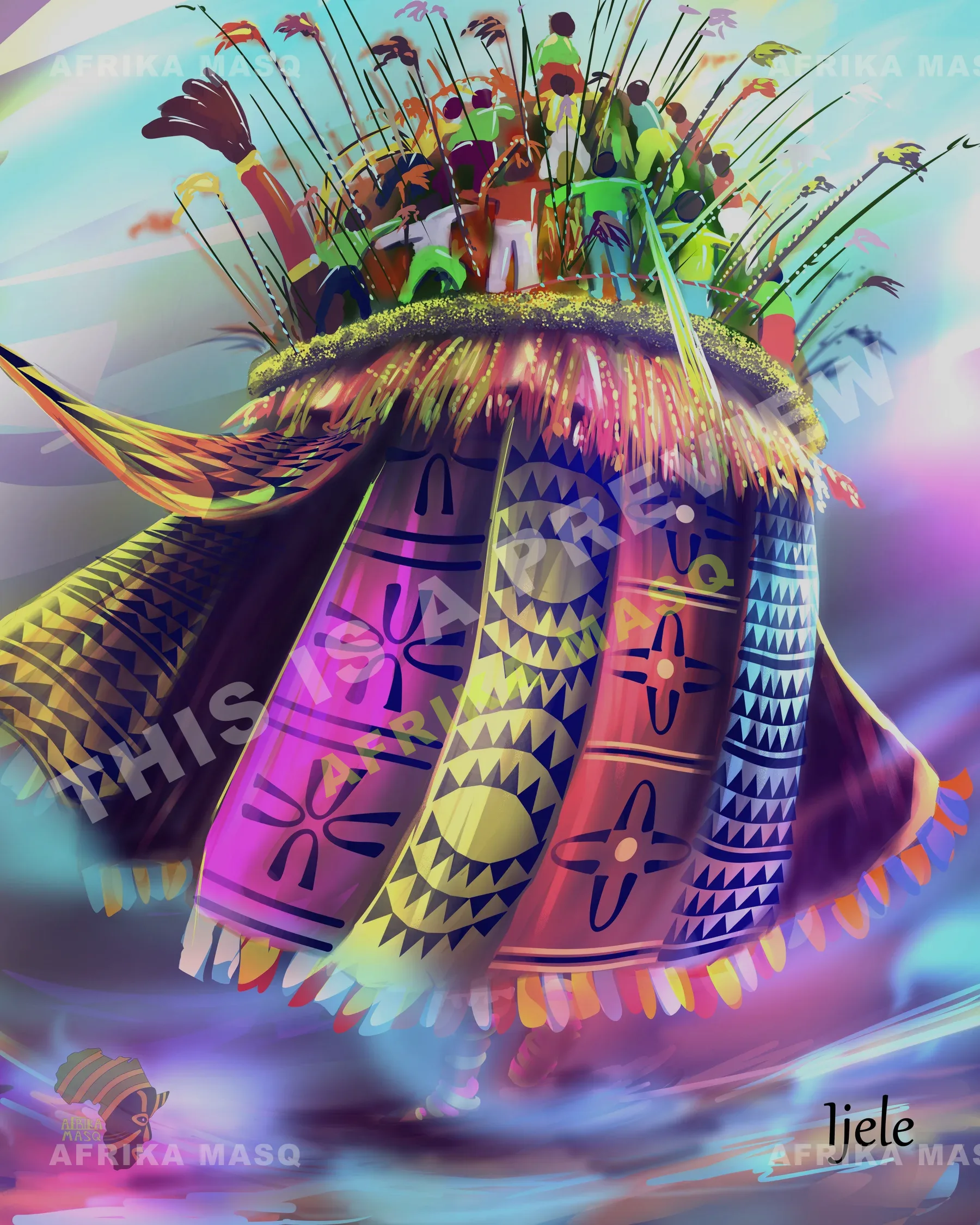
Seeing The Afrika Masq Artwork
The Afrika Masq artwork should be approached as a contemporary tribute.
It cannot contain everything Ijele is. No single image can hold the labour of preparation, the pressure on the carrier's body, the music of the flute, the songs around the arena, the authority of attendants, the history of community custodianship, or the emotional atmosphere of a public appearance.
But an image can open a door.
The artwork can make a viewer pause long enough to ask better questions. Why is the figure so tall? Why does the form feel layered? Why does the central structure matter? Why is colour doing more than decoration? Why does the masquerade feel ceremonial rather than simply ornamental?
That is where Afrika Masq becomes more than an art archive. The image draws the eye. The story deepens the encounter.
Why Ijele Matters
Ijele matters because it refuses smallness.
It is too tall to be reduced to a costume. Too layered to be reduced to a symbol. Too communal to be reduced to one maker. Too musical to be reduced to a still image. Too culturally rooted to be treated as a decorative style.
It stands at the meeting point of art, music, memory, public ceremony, social authority, spiritual imagination, and communal labour. It reminds the viewer that African masquerade traditions are not museum fragments waiting to be admired from a distance. They are living systems of knowledge, carried by communities and renewed through performance.
For Afrika Masq, Ijele should become a standard for how every masquerade story is handled. The objective is to make the art harder to misunderstand.
The artwork is the doorway. The story is the invitation to enter with care.
Help improve this record: if you are an Igbo, Anambra, Omambala, Ijele, masquerade, music, or cultural-history custodian, researcher, practitioner, or reader with stronger references, share a comment below with the source and context. Verified contributions can be credited in future updates.
Comments
Join the conversation
Share your thoughts on this story. If you notice a correction, missing context, or a useful reference, include it and we will review it before publishing.
Loading comments...