More Than A Masquerade
Ekpe should not be introduced as only a colourful masquerade.
In Calabar and the wider Cross River region, Ekpe is also a society, a public institution, a system of rank, a language of signs, a performance tradition, and a form of authority. In related communities it may be called Mgbe or Egbo, and its histories cross ethnic, linguistic, regional, and diaspora boundaries.
This complexity matters because a viewer may first meet Ekpe through costume, colour, sound, or movement. But the performance belongs to a deeper system. Nigeria-based writing, University of Calabar-linked work, and Jordan Fenton's scholarship all stress that Ekpe remains socially meaningful, not merely decorative or recreational.
For Afrika Masq, Ekpe is one of the clearest examples of why masquerade art needs context. The image is powerful, but the institution behind the image is larger than the visual surface.
Calabar, Cross River, And A Wider Network
Ekpe is strongly associated with Efik Calabar, but it should not be trapped inside one narrow label.
Public scholarship describes Ekpe/Mgbe as a renowned cultural institution of the Cross River region, including southeastern Nigeria and western Cameroon. Efik, Ejagham, Qua, Ibibio, Oron, Aro, and other related histories appear in different accounts of Ekpe, Mgbe, nsibidi, and leopard society traditions. Some origin claims are debated or locally specific, so this article uses careful wording rather than pretending one outside summary can settle the matter.
The safest public framing is that Ekpe is central to Efik/Calabar public culture and part of a wider Cross River cultural world. That wider world includes shared and adapted systems of signs, cloth, performance, prestige, initiation, and social authority.
That is not vagueness. It is respect for a tradition whose routes are older, wider, and more contested than a single modern ethnic label.
Nsibidi And The Cloth That Carries Knowledge
One of Ekpe's most important visual languages is nsibidi.
The Hood Museum's ukara publication describes nsibidi as a body of ideographic, abstract, and gestural signs used by the Ekpe Society as coded communication. Ukara cloth, plain cotton transformed through indigo-dyed nsibidi signs, can function as a ritual object and as a public sign of guarded knowledge.
Nigeria-based research by Babson Ajibade, Esther Ekpe, and Theodora Bassey is especially useful because it studies how nsibidi signs on Efik ukara cloth changed or adapted when transmitted into Efik cultural space in Calabar. Their fieldwork-based argument helps avoid a flat story. Nsibidi is not merely an ancient design system placed on cloth. It is a living, adaptive visual language shaped by movement between communities.
This is why the artwork should not treat pattern as decoration. In Ekpe, signs can point toward authority, secrecy, membership, rank, and controlled knowledge.
Rank, Secrecy, And Public Presence
Ekpe is public and guarded at the same time.
That tension is part of its power. Some events, cloths, gestures, sounds, processions, and masquerade appearances are visible in public. But membership, rank, ritual knowledge, and some meanings remain controlled by the society and its custodians. A public article should honour that boundary.
The point is not to make Ekpe sound mysterious for effect. The point is to recognize that not all knowledge is meant to be extracted, translated, and published. Ekpe teaches that public beauty can sit beside restricted knowledge without contradiction.
For readers, this means humility. You can learn from public sources, from scholars, from museums, from community-facing writing, and from contemporary Calabar performance. But you should not assume that seeing the masquerade means possessing the institution.
Power In The Streets
Jordan Fenton's work on Ekpe/Mgbe in contemporary Calabar is important because it moves Ekpe away from the idea of a fading relic.
His research describes Ekpe/Mgbe power being performed in urban public space: ritual, masquerade, nsibidi, money, prestige, and social negotiation move into streets and public events. This does not erase older authority. It shows how the institution adapts to modern Calabar, where heritage, tourism, urbanisation, identity, and social display all meet.
Ekpe therefore belongs to the present tense. It can appear at festivals, public celebrations, cultural displays, and community events, while still carrying older systems of rank and obligation. It is not simply a staged survival of the past.
A living institution has to move through changing streets.
Ekpe, Order, And Community Life
Nigeria-based scholarship on the present-day relevance of Ekpe to the Efik describes the society as historically connected to community roles beyond spectacle. Related writing on Old Calabar also discusses Ekpe as a political and social mechanism for security, order, and development.
These claims need careful handling because historical roles, contemporary practices, and public performances may not be identical. Still, they help explain why Ekpe should not be reduced to a mask worn for entertainment. The performance points to older forms of social organization, authority, enforcement, prestige, belonging, and communication.
The masquerade, the cloth, the signs, the rank system, the sound, the procession, and the public response all form part of that larger picture. Ekpe is not just seen. It is recognized.
Modern Pressure And The Risk Of Flattening
Ekpe faces a familiar pressure: the world wants images faster than it wants context.
Carnival culture, tourism photography, social media, and decorative use of nsibidi-inspired designs can make Ekpe highly visible while flattening the institution behind it. At the same time, public performance can keep heritage active, bring younger audiences into contact with tradition, and make Calabar's cultural identity visible in modern urban life.
A respectful article should hold both truths. Visibility can help. Visibility can also distort. The task is not to hide Ekpe, but to present public knowledge with restraint, source discipline, and respect for custodianship.
That is why Afrika Masq should describe Ekpe as a living cultural institution first and an artwork subject second.
Seeing The Afrika Masq Artwork
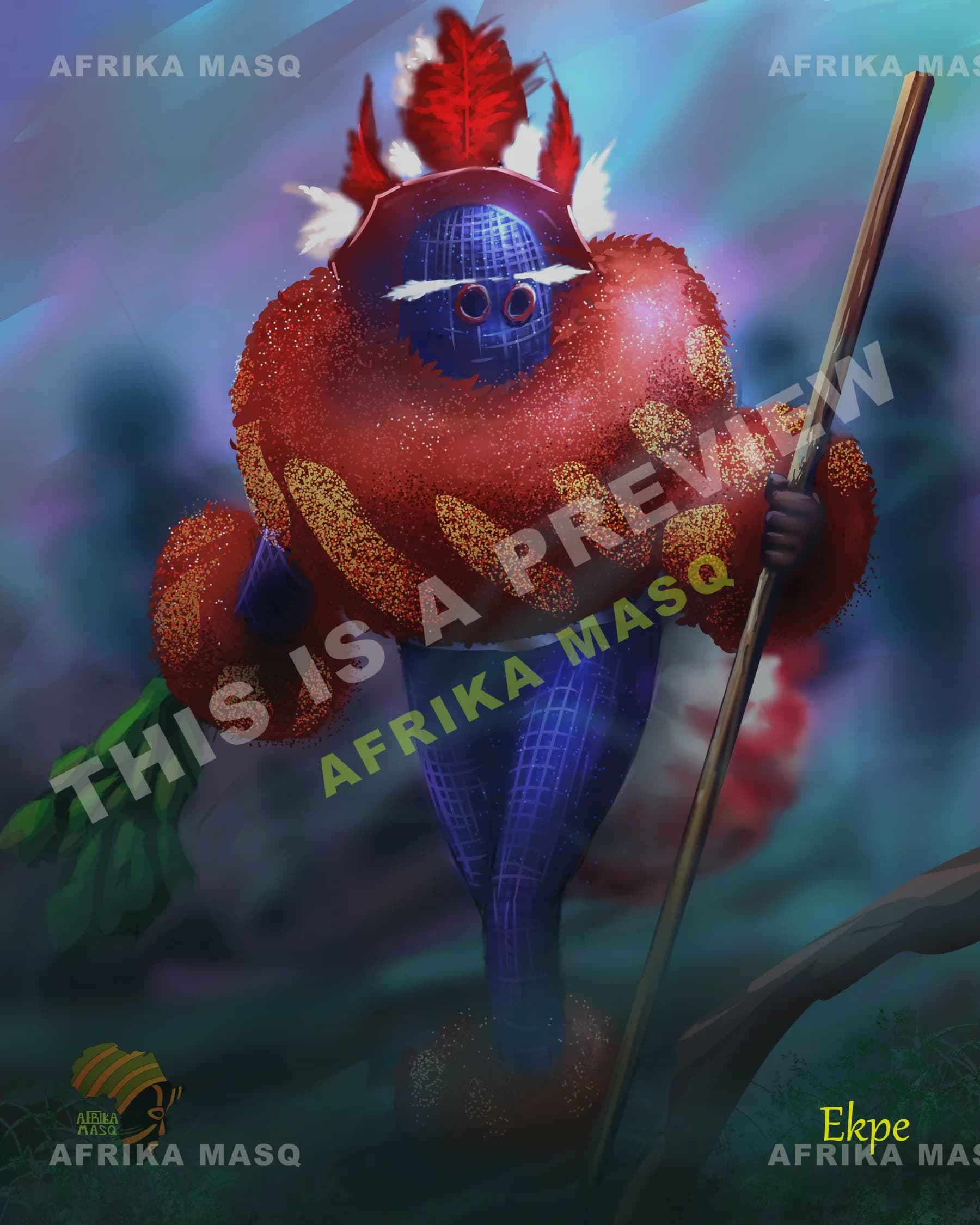
The Afrika Masq Ekpe artwork is a contemporary interpretation of public presence, dignity, coded knowledge, and authority.
It should not claim to reproduce the society. It should not treat nsibidi-like marks as random ornament. It should not imply that a viewer can understand all levels of meaning by looking at one image. Its value is in drawing attention toward Calabar, Cross River history, Efik cultural life, guarded knowledge, and the living public force of Ekpe/Mgbe.
For collectors and readers, the right response is not possession but attention. What does the cloth signal? What does the performance reveal? What does it deliberately keep hidden? How does authority become visible without becoming fully disclosed?
Those questions make the artwork more meaningful.
Why Ekpe Matters
Ekpe matters because it shows that masquerade can be an institution.
It can hold law, rank, prestige, communication, secrecy, beauty, money, street power, performance, and cultural identity together. It can remain active in a city without becoming only a tourist image. It can adapt without becoming empty.
For Afrika Masq, Ekpe sets a high standard for cultural writing. The article must be public enough to educate, careful enough not to expose what should remain guarded, and close enough to source-country scholarship that Calabar is not spoken over by distant summaries.
Help improve this record: if you are an Efik, Cross River, Calabar, Ekpe/Mgbe, nsibidi, or regional cultural custodian, researcher, practitioner, or reader with stronger references, share a comment below with the source and context. Verified contributions can be credited in future updates.
Comments
Join the conversation
Share your thoughts on this story. If you notice a correction, missing context, or a useful reference, include it and we will review it before publishing.
Loading comments...