A Mask Is Not Only The Face
A Dogon mask should not be understood as only the carved form that a museum can place on a wall.
In Dogon masquerade, the visible headpiece is only one part of a larger being. Costume, fibre, paint, paraphernalia, rhythm, movement, space, age group, audience, and ceremony all matter. Walter van Beek's study of the kanaga mask makes this point sharply: in Dogon usage, what outsiders call a mask is closer to the full apparition, the complete performed presence that appears in motion.
That distinction is important for Afrika Masq. If the archive shows only an image and does not restore the ceremony around it, it risks reducing a living performance system to a collectible shape. Dogon masquerade asks for a slower gaze. The viewer has to imagine dust, drums, bodies, heat, watching elders, youth competing in skill, and the repeated movement through village space.
The mask is not merely something worn. It is something that arrives.
Dogon Country And The Dama
Dogon communities are most often associated with the Bandiagara escarpment and surrounding areas of central Mali. Public writing on Dogon mask traditions frequently returns to dama, an end-of-mourning or second-funeral ceremony that may occur long after burial.
Museum records from the Metropolitan Museum of Art describe dama performances as helping transport the souls of deceased family members away from the village and as honouring the prestige of the deceased and their descendants through masked performance and hospitality. Van Beek's ethnographic account adds another layer: the dama is not only a single performance but a complex sequence of arrivals, dances, movements through village space, feasting, and social participation.
The ceremony is connected to death, but it is not only about death. It also renews life. Public scholarship discusses how dama can link mourning, fertility, social memory, and the return of order after disruption. That does not mean every symbol has one fixed explanation. Dogon communities, villages, age groups, and sources may interpret or emphasize details differently.
The careful public wording is this: Dogon masks appear within ceremonies where the community works through death, remembrance, prestige, transition, and renewed social life.
Awa, Preparation, And Public Boundaries
Many public sources connect Dogon mask performance with the Awa, often described as a men's mask society. The Smithsonian and museum teaching sources note that kanaga and related masks are traditionally danced by initiated male members in dama contexts.
This is one of the places where an educational article has to show restraint. Public sources can describe the basic social frame: preparation, carving, costume work, rehearsal, rhythm, procession, village participation, and the role of initiated performers. But the article should not pretend to reveal restricted knowledge or reduce the society to secrecy for dramatic effect.
Preparation matters because it proves that the public appearance is only the visible end of a longer process. The dancer does not simply pick up a headpiece and entertain a crowd. He enters a role shaped by practice, instruction, bodily discipline, ceremonial order, and community expectation.
For a viewer encountering the Afrika Masq artwork, this changes the question. Instead of asking only what the mask means, ask what kind of preparation makes such a presence possible.
Kanaga And The Danger Of One Famous Shape
The kanaga is the Dogon mask form many global viewers recognize first. Its double-barred structure appears in museums, books, tourist imagery, and older national visual references connected to Mali. Because it is so visible, it can easily become a shortcut for all Dogon masquerade.
That shortcut is risky. The Met notes that kanaga was highly represented in a dama witnessed by Marcel Griaule in 1935, but Dogon masquerade includes many forms. Van Beek describes masks portraying animals from the bush, human figures, social types, and other presences. Museum records also point to walu, sim, hare, monkey, bird, antelope, buffalo, and other types.
Even the kanaga itself has layered interpretations. Some sources discuss birds, others discuss cosmic order, others focus on movement, competition, youth, bush-village transition, and the embodied force of the dancer. A responsible article should not pretend that one explanation settles the matter.
The better approach is to keep the kanaga inside the moving troupe. It is famous, but it is not alone.
Movement, Dust, Rhythm, And Judgment
Dogon masquerade is judged in motion.
Van Beek describes lines of kanaga dancers bending, sweeping the headpieces close to the ground, stirring dust, and responding to specific drum rhythms. Other mask types move differently. The point is not only that masks dance, but that each kind of mask has a way of moving, a rhythm, a performative expectation, and a public standard of skill.
The audience does not simply watch passively. Elders encourage, correct, and shout. Villagers and visitors respond. Young performers compete gently for recognition. The village aims for a successful dama, and individual dancers try to show strength, stamina, timing, and convincing transformation.
This is why still photography can mislead. A headpiece without movement is not the full event. The real force of the masquerade comes when wood, fibre, body, rhythm, dust, and social recognition all meet in one field.
Death, Fertility, And The Return Of Order
Many public explanations of Dogon dama focus on escorting the dead. That is true as far as it goes, but the ceremony is also about the living.
The death of a person disturbs social and cosmic order. The dama helps the community respond. Through masked movement, hospitality, public gathering, and ritual sequence, the deceased is remembered and the living community re-forms itself. Van Beek's work discusses the relation between death and fertility, suggesting that the ceremony links mourning to renewed life rather than treating them as separate worlds.
This should be written carefully. Afrika Masq should not overclaim a single theological explanation for all Dogon communities. But it can say that Dogon mask performance, especially in dama contexts, makes death public, structured, and answerable through collective action.
The masks appear where the community has to carry grief forward.
Modern Pressure, Tourism, And Change
Dogon masquerade is not frozen in an old ethnographic photograph.
Public museum sources note that dama performances have sometimes been staged more frequently for visitors and tourists. Van Beek's account of names written on kanaga headpieces in the late twentieth century shows another kind of change: schooling, literacy, youth distinction, elder regulation, and the tension between public secrecy and modern visibility.
These pressures are not simple. Tourism can flatten a ceremony into spectacle, but public performance can also create income, recognition, and new forms of cultural continuation. Schooling, Islam, Christianity, state heritage language, migration, insecurity in parts of Mali, and the global circulation of Dogon objects all affect how the tradition is seen and practiced.
A respectful article should avoid the fantasy of untouched culture. Living traditions survive through negotiation.
Seeing The Afrika Masq Artwork
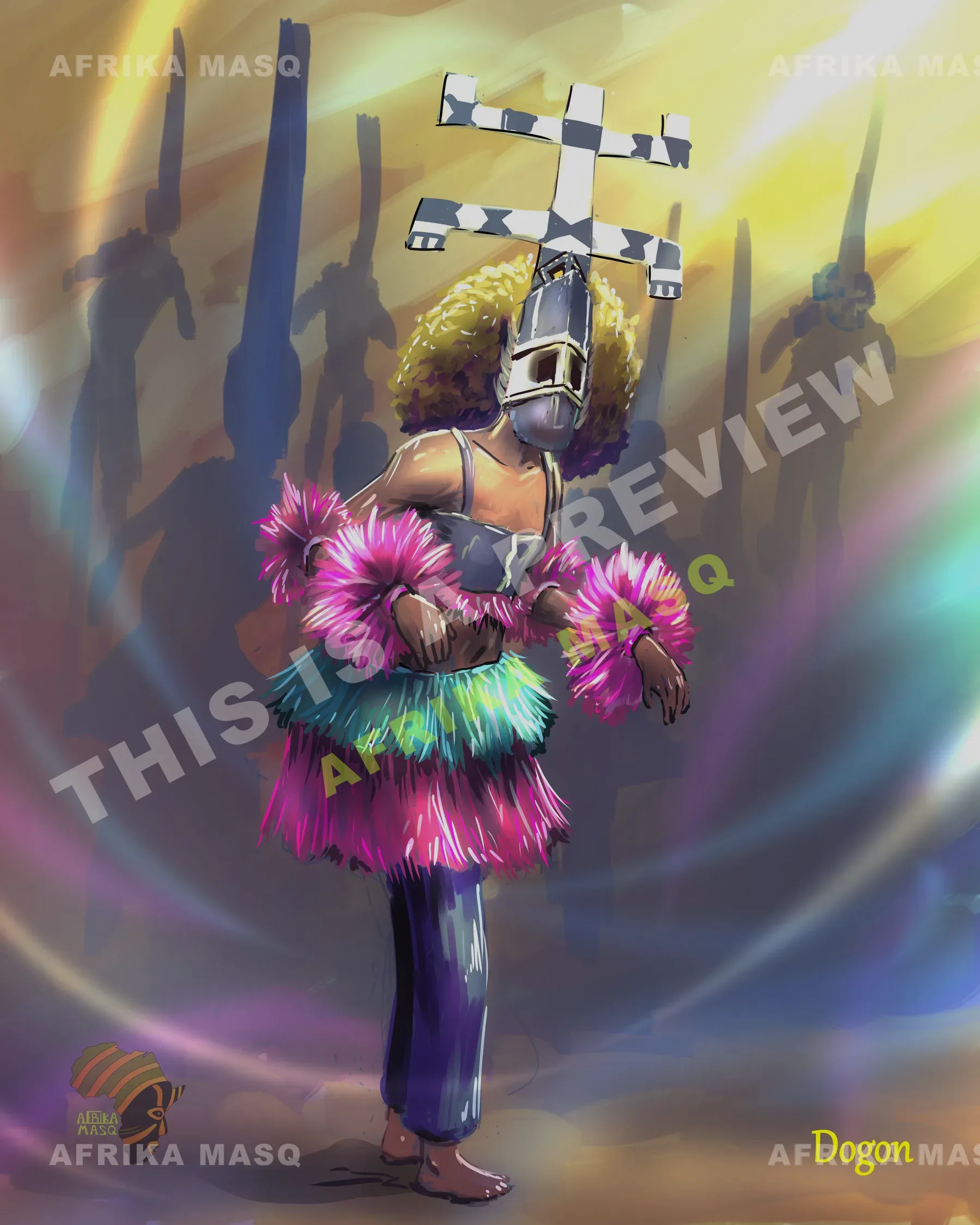
The Afrika Masq Dogon artwork should be approached as a contemporary tribute to presence in motion.
It cannot reproduce a dama. It cannot carry the drum rhythm, the dust, the rules of Awa participation, the full costume, the hospitality, the grief of a family, or the social force of a village gathering. What it can do is open attention toward those things.
The artwork invites viewers to move beyond the famous silhouette and ask better questions: Who dances? What does the public see, and what remains restricted? How does a mask become a full apparition? How does a community use movement to carry memory from death toward renewed life?
That is the educational task. The image catches the eye. The story restores the world around it.
Why Dogon Masquerade Matters
Dogon masquerade matters because it teaches that memory is not only spoken. It can be danced.
It turns mourning into public action. It turns a carved headpiece into a full moving presence. It joins body, fibre, rhythm, community, and ceremony so that death does not remain only private loss. It becomes part of a larger process of remembrance, prestige, fertility, and continuity.
For Afrika Masq, Dogon is a reminder that an archive must resist the easiest image. The kanaga may be iconic, but the deeper story is movement, social order, and the care required when writing about living traditions from outside them.
Help improve this record: if you are a Dogon cultural custodian, researcher, practitioner, or reader with stronger Mali-based references for Dogon dama and mask performance, share a comment below with the source and context. Verified contributions can be credited in future updates.
Comments
Join the conversation
Share your thoughts on this story. If you notice a correction, missing context, or a useful reference, include it and we will review it before publishing.
Loading comments...